Resilience

30 Days 30 Ways: Day 2

30 Days 30 Ways: Day 2

Reading Time: 2 minutes

My self-imposed task to complete the UK and USA challenges continues…

UK Challenge 2 – Talk to your children about road safety and share a road safety message on social media

Chicken-crossing-the-road2

If you’ve experienced crossing a street with me you’ll know that I take road safety very seriously. Sadly my cautiousness hasn’t rubbed off on one of my friends, who has been hit by a car on four occasions (fortunately not seriously).

I know the Green Cross Code is a thing…but if I’m honest, I couldn’t tell you what it was. I posed the same question to my housemates…“Stop. Look. Listen.” they cried, putting me to shame.

Growing up I remember TV road safety promotional films with a man in a questionable green outfit, and one with some hedgehogs. Today’s TV (and YouTube) films are more graphic, depicting snapping bones, perforated lungs and craniums hitting asphalt.

Although it’s not specifically road safety and it’s from down under, the Dumb Ways To Die campaign was a viral hit, having been watched by over 110 million people. It’s actually impossible not to sing the jingle after watching the clip.

This got me to wondering, is there any evidence that ‘shock tactics’ work any better than cute animated cartoons?

USA Challenge 2 – identify who is in charge of emergency preparedness where you live, reach out to them and let them know you’re playing 30Days30Ways.

Ok, this is a super easy task – it’s me! You can find out more about me or connect with London Resilience Team for more information about emergency preparedness in London. In fulfilment of the challenge, I’ll also share a link to a useful twitter list of official emergency planning accounts in the UK.

Last year I made an estimate that there are 8,500 emergency planners across the UK. Despite restructures and budget cuts, I think I’m still comfortable that this figure is ‘about right’, meaning that on average there is one ten-thousandth of an emergency planner per person.

I’m sure there are some massive errors in my calculations (let me know how I could improve my estimate!). However, what this also highlights is another reason that we should all take responsibility for preparing for emergencies. Something my SMEM colleague Mary Jo Flynn put very succinctly earlier:

Preparedness, response and recovery is a shared responsibility #EveryonesJob #30Days30ways

A photo posted by @mjflynn001 on

30 Days 30 Ways – UK vs USA

30 Days 30 Ways – UK vs USA

Reading Time: 3 minutes

You may remember that I participated in the American initiative 30 Days 30 Ways last September. It’s a monthly series of daily challenges designed to be simple tasks to help improve emergency preparedness. This year, colleagues in Northamptonshire have also developed a UK version.

Having a local version of the game is great. I found lots of the challenges last year rather difficult and the reason that I gave for this was down to different structures and practices. However, I drew this conclusion with very limited evidence….

Big Brother Eye and EP

As I’m involved in promoting #30Days30WaysUK, and therefore know the list of challenges, it would be a bit of a conflict of interests for me to participate properly. Instead, I’ve set myself the rather impossible challenge of competing tasks from both the UK and USA versions with a view to drawing out similarities and differences.

Each day (or as often as I can) I’ll provide my ‘answers’ to both the UK and International challenges. Where I can I’ll also provide trackbacks to my musings last year.

UK Challenge 1 – talk about emergency preparedness and develop a grab bag

Ok, part one is easy, I talk about emergency planning fairly often, although mostly in a work context rather than how I would actually respond myself.

Those who know me will have heard about my Zombie Apocalypse bag. In reality it’s more of a series of small packs that I’ve stashed in various locations (not just at home) which have some essential items.

There isn’t so much of a grab bag culture in the UK. I think this is largely because we don’t face many of the acute risks that other places do. UK citizens are unlikely to be directly affected by earthquakes, volcanoes or hurricanes, so I’m not convinced that encouraging members they need to be able to live ‘off the grid’ for 3 days would ever have any traction. I do though, think there is merit in having situation dependant grab bags – live in a flood zone, then have a flood kit prepared; driving in the winter, better pack your winter car kit.

I despise checklists, especially when it comes to grab bags. There isn’t one bag to rule them all. Each of us need to tailor the contents to specific actual and perceived needs.

Many of us pack grab bags on a daily basis – whether it’s children’s school bags or the bags we each take to work. They contain what we think we need to get through the day. If you have a gym bag, it has the necessary items you’ll need for your workout. If you’re pregnant then your grab bag for the hospital contains essentials for mother and baby in the first few hours. A grab bag for emergencies is really no different – some key items that might make the disruption more bearable, but as different emergencies would have different impact I’m not keen on the grab-bag-by-numbers approach.

So, whilst I won’t be consolidating my grab bags into one, I’ll stick to maintaining my series of pick’n’mix grab packs!

USA Challenge 1 – Share a sign that illustrates a preparedness message

Any tourist that’s been to London in the last 8 years will know that you can’t move for souvenirs plastered with the Keep Calm and Carry On logo. It’s a fantastically simple message, but I thought it was too obvious a choice.

kcaco

So after some head scratching and googling I opted for this sign taken about 20 mins from where I live, regarding the Oak Processionary Moth.

opm

Although recently removed from the London Risk Register this remains my favourite (and by far the cutest) risk I have been involved with!

In case it’s not something you’re familiar with, the spines on the caterpillars can aggravate existing respiratory conditions such as asthma, but the little critters can also do damage to oak trees themselves.

Day 1 down, just 29 more to go!


Oh, and the top image is ‘adapted’ from this years Celebrity Big Brother logo. If the big wigs at Endemol don’t like my edits then I’ll remove it, until then I’ll take my chances!

What can annoying kids teach emergency planners?

What can annoying kids teach emergency planners?

Reading Time: 3 minutes

If you were following my tweets last week you’d have noticed a constant stream from the Emergency Planning College ‘The Art of Really Learning Lessons’ seminar. An issue I blogged about two years ago!

littlekidwhy

Whilst this sounds like the sort of event that would be organised by the W1A Way Ahead Taskforce it was actually the most engaging and thought provoking event I have attended at the EPC. A special shout-out to Dr Lucy Easthope who was magnificent as Master of Ceremonies!

Reflecting on the past couple of days, I think we need to be more like children. Whilst there can be few things more exasperating than a child that persists in asking “Why?”, it’s actually a pretty great strategy for learning.

Only a fool learns from his own mistakes. The wise man learns from the mistakes of others.

Well yes, Bismark was probably onto something that lessons are often transferrable, but as several speakers pointed out; they are also highly contextualised and are viewed with the benefit of hindsight. There’s probably some deep psychology at play here about why we learn from our own experience more, and why ‘stories’ are more persuasive than ‘facts’. This linked in to comments made during the seminar about the balance between tacit and explicit knowledge.

Dr Kevin Pollock’s comments on Mock Bureaucracy really seemed to resonate with the audience – organisations with a front designed to impress key stakeholders with principles and well ordered practices whilst hiding internal fragmentation and ad hoc operation’

It’s undoubtedly positive that there’s such interest in really learning lessons. However, I had two frustrations

  1. That we’re often overly critical of actually how much progress we have made. Although people might moan about it, the reason that the UK is so highly regulated (building codes, health and safety, child protection, care quality etc) is as a direct consequence of learning from past incidents and implementing procedures which reduce recurrence.
  2. That we don’t make the most of existing knowledge. Safety critical industries such as aviation and nuclear have been grappling with these issues for decades. It was therefore fantastic to hear from Paul Sledzik of NTSB on learning from the transport industry in the United States.

Are we really learning anything?

Many of the speakers asserted the need for a ‘safe space’ to share information, the trust and candour to be able to share lessons without fear of repercussions. There are already examples; for example the ‘Chicago’ meetings of the NTSB and the CISP structure for cyber incident recording. Will JESIP Joint Organisational Learning or the forthcoming Lessons Emergency and Exercises Platform provide the same level of safety? I worry that they could add to the ‘mock bureaucracy’ if not simultaneously accompanied with cultural change to embrace lessons.

Identification of a lesson is easy. Where that relates to a system or a process the fix is also relatively straightforward. However, double loop learning, where the root cause of the issue relates to the culture, values of beliefs of an organisation is much harder.

The overriding message of the NTSB keynote was not to forget who we’re doing all this emergency planning for. It is impossible to plan for (or even to concieve of) every eventuality. All emergencies are different, and all people are affected by them differently. However, we should not loose sight that at the end of the processes that we use are people, families and communities.

Emergency Planning is typically based on risk. As Lucy Easthope was speaking today, and reflecting on Paul Sledzik’s comments on expectation vs reality, I wondered about an alternative approach:

So in addition to developing capability to respond to flooding/zombies/whatever we could build public narratives…for instance…

  • When a building collapses and kills my loved one
  • I want to get their personal possessions returned to me quickly
  • So I can process grief in the least traumatic way

Now that’s just an experiment, and I’m sure it could be further developed, but would that sort of approach help refocus on ‘why’ we’re doing what we’re doing rather than ‘how’ we’re doing it?  

And…just like that annoying kid at the start of the article…we come back to why.

What did an Emergency Manager think of San Andreas?

What did an Emergency Manager think of San Andreas?

Reading Time: 5 minutes

It’s a running theme for me to blog about disaster movies, so here’s my latest installment, after watching San Andreas yesterday evening. CAUTION: contains spoilers!

10409537_763663080395662_6405374869058751228_n

San Andreas (not the most inspired title) see’s Dwayne “The Rock” Johnson as a helicopter rescue pilot go rogue to save his family from the largest earthquake ever recorded.

As disaster films go, it borrows fairly heavily from Emmerich’s standard formula:

  1. Heroic estranged father
  2. Scientist with a grave theory
  3. Early destruction of a landmark (in this case, the ‘bursting’ of the Hoover Dam). This is also the point that the scientist will say something like “we haven’t seen the worst of it yet”
  4. Separate a family
  5. Turn up the destruction to 11
  6. Reunite said family
  7. God Bless America

So although it was forumulaic, how did it rate from the presepctive of an emergency manager?

Earthquake and Tsunami Risk

First up, many of the situations presented in the film could not happen. The San Andreas fault is a strike-slip fault (or more accurately, a transform fault). This means the earth’s tectonic plates are sliding past each other. If they get stuck, pressure is built up, which is released as an earthquake. However, this wouldn’t be the sort of earthquake to open up massive canyons. It would still be destructive, but not in the same way as presented.

Further, the film depicts a tsunami engulfing San Fransisco.

anigif_longform-original-951-1432935592-21

Yes, San Fran has a real tsunami risk and has a warning system in place. However, this wouldn’t be caused by an earthquake with an epicentre on the San Andreas fault as large volumes of water are not vertically displaced when plates slide against each other.

The map below shows, in red, the official ‘tsunami risk zone’, and in blue my illustration of the extent affected in the movie (based on what landmarks were underwater and my very limited geographical knowledge of SF!). As you can see, the film uses more than a pinch of dramatic license!

SFTsunami

Drop, Cover and Hold On

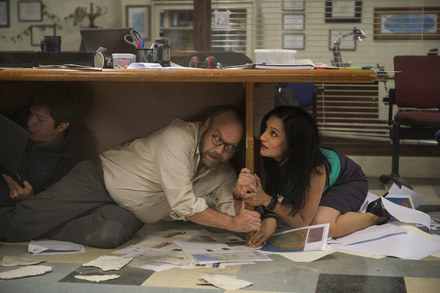
This phrase is actually used, and demonstrated, on a number of occasions by the trusty scientist and his sidekick journalist (who is none other than The Good Wife’s Archie Panjabi).
longform-1027-1432935532-8

Later, The Rock explains what you should do if you can’t find cover. I’ve gotta give them some serious credit for including this, it really is the best thing to do.

CDH

If Kylie Minogue’s character had followed that advice maybe her blink-and-you’ll-miss-her-falling-out-of-a-building cameo would have been avoided.

Casualties and Fatalities

In the film we see Blake (The Rock’s on screen daughter) construct a rudimentary tourniquet to stop bleeding and see The Rock performing CPR. Knowing some very basic first aid can be life saving.

However, one stange thing is that given the scale of the disaster, the movie is notably free of the (presumably) hundreds of thousands of dead bodies. My only explanation for this? That the call to evacuate came just in the nick of time!

Mass Evacuation and Shelter

The usual scenes of highways packed full of cars (and debris) abound, but fortunately our protagonist has access to helicopters, planes and boats to get around such inconvieniences.

This brings me to my main issue with the film, The Rock’s self-deployment. As a Search and Rescue specialist he would have been much more useful assisting the official response, than focusing on his own family. that might sound cold-hearted but, to me, the ethics of emergency management hinge on doing ‘the most for the most’.

But back to evacuation and shelter, when nature runs out of things to throw at the Bay Area, there are some perfunctory scenes of tented villages, and mentions of support from FEMA and the UN. Fact – these tents were supplied by genuine emergency response organisation ShelterBox!

Command and Control

Clearly the producers had been reading up on the UK Joint Emergency Service Interoperability Principles. Whilst the film isn’t about emergency management (for shame!) there were some subtle mentions of emergency services protocols.

Most notably, when Blake steals (yes, it’s resourceful, but it is still stealing!) the fire radio to listen to the “multi agency Tactical Command channel that all areas have for emergencies” which sounds a lot like the multi agency talkgroups on Airwave.

Communications

Whilst the idea of using a landline phone was good, there is an inherent assumption that the physical infrastructure remains intact. Phone lines could have been damaged. I forget what actually happened to her mobile phone, but if possible Blake would have been better sending a text first (less bandwidth so more chance of the message getting through).

Community

Bar the occasional scene of people looking disheveled the film has very little focus on anyone that isn’t The Rock, his ex wife or his daughter.

Certainly in America, we’ve seen communities   come together under their national or local identity (e.g. see post 9/11 response and Boston Strong). However, none of that really featured in this movie.

On the other hand though, there is the ‘classic’ scene of looting, which flies in the face of most evidence from real disasters which suggests pro-social behaviour.

The display of patriotism at the end (where three military helicopters drape a star spangled banner on (what is left of) the Golden Gate Bridge was a touch over the top!

Overall

For all it’s flaws, I enjoyed San Andreas.

It left a slightly bitter aftertaste that most of California had to be destroyed in order to reunite one family, but I appreciate the need for ‘narrative’. However, maybe a better balance could be struck between widespread disaster and micro-level drama?

If you’re a fan of disaster movies head over to Buzzfeed to see if you can match the screengrab to the film!

The gestation of exercise artificiality

The gestation of exercise artificiality

Reading Time: 3 minutes

The theme for Business Continuity Awareness Week 2015 is about the value of exercising and testing plans. Having facilitated, participated and observed in my fair share of exercises over the last 8 years I’ve reached the conclusion that they’re a waste of time. Worse than that, I think a bad exercise can do more harm than good. I know that’s not going to be popular, so let me explain what I mean…

The process of exercising is designed to validate the assumptions in a plan (or elements of a plan). This is a process which I absolutely think is necessary, but one which, all to often, isn’t effective.

From full-blown reconstructions to glossy media injects, exercise planners or consultants do their best to make the exercise environment realistic. However, this realism tends to evaporate quickly.

I think the problem with exercising starts in the planning phase. Committees meet for months before an exercise to determine locations to use, dates and times, who should participate and what scenarios to use. I think these conversations are pointless, here’s why:

Location: Don’t take people out to a nice conference venue. Yes it’s lovely to have refreshments on tap, but does it familiarise people with the locations they could be working in? If your plan identifies an emergency operations centre, use it! If that facility has a ‘business as usual’ function then make staff there aware that it also serves another function and so they need a business continuity plan themselves! If your facilities are poor all the more reason to use them – it might just help secure investment!

Date and Time: Incidents often happen without warning, therefore so should your exercises. There are some dangers associated with no-notice exercises, but planning in advance can mitigate this. Nor do incidents always respect the convenience of occurring within office hours. Think about conducting your exercises outside of normal office hours. A plan that works effectively at 3am on a Sunday is a good plan!

Invitees: Don’t invite people to your exercise. That might sound a bit odd, but anyone with a defined role in a plan has a responsibility to participate in exercises. The planning process should identify 24/7 contact details for people able to undertake the roles identified. Use those contacts! For instance: if you have a Duty Director on-call, call them. If you use a telephone tree or other alerting system, test it in anger to see if it works.

Scenario: Unlike the three aspects above, picking the right scenario is important. However, beware of falling into the trap of picking a scenario and designing objectives to fit. The focus should be on your capability to respond to issues, the scenario is just a vehicle to facilitate that.

In my opinion, the only two aspects that should be discussed before an exercise are the objectives (what are you trying to learn) and the evaluation (how do you plan to learn it).

Objectives: Exercises really do work best when the objectives are specific and measurable. Specific objectives need to be developed at a high level in advance of the exercise. They should be made clear to all participants so they have a shred understanding about the purpose of the exercise. Don’t be scared of having lots of specific objectives, they’re far more useful than an all-encompassing generic objective like “demonstrate an understanding of plans and procedures”.

Evaluation: There is no correlation between the size of an exercise and its utility. If you’re only interested in whether people can communicate then think about a simple communications test. If you’re interested in how people perform under pressure then look at job-task analyses. The easier an objective is to measure objectively the more confident you can be in your evaluation. Part of your evaluation discussion should also identify the next steps. Have a system in place to make sure you don’t learn identical lessons from one exercise to the next.

Avoid the pitfalls, concentrate on the objectives and exercises can be useful in validating your plans. Happy Business Continuity Week!

Help me find a wild goose!

Help me find a wild goose!

Reading Time: 2 minutes

What started as a good idea has got me stumped, and I need your help! I’m on the hunt for the first edition of the London Emergency Services Liaison Panel Major Incident Procedures Manual. Snappy title huh?!

It was published in hard copy only in, or around 1986, and was the first attempt to describe the multi agency response to a civil emergency.

  • Are you an emergency planner with an extensive library?
  • Do you know any ex police/fire/ambulance staff? Are they a bit of a hoarder?
  • If so, share this post with them or encourage them to contact me!

Why am I after a document that’s as old as I am?

LESLP started life in different times. Whilst many of the risks that London faced in 1973 are the same in 2015, others have changed and more have been identified (hello: cyber hacking). However, it’s not just the risks that change, the capacity and capability to respond have also changed.

It’s hard to look at how things have changed when you weren’t there to experience it first hand. From the outside the police in 2015 is markedly different to the Life on Mars image I have in my mind. Similarly for the other emergency services, there has been massive change not just in terms of what can be done, but also in how things are done.

A couple of years ago, as a response to Lady Justice Hallett’s inquest report, the Home Office initiated the Joint Emergency Services Interoperability Programme. The aim was to develop national consistency regarding major and complex incident response. However, in London LESLP has been in place for over 40 years, and there was a sense from some corners of ‘we already do that’. True, the LESLP procedures do call for joint working and articulate organisational roles and responsibilities. However, I thought, wouldn’t it be an interesting exercise to compare Version 1 with Version 9 to see how things have changed? How have lessons from incidents have been incorporated into policy? What about international best practise and changes in national response capability, have they been included? And most importantly of all, wouldn’t this sort of historical analysis make for a fine blog piece!

However, tracking down the first edition is proving to be more problematic than I initially thought! The Met Police are the document owners, but the my colleagues there don’t have a copy. I’ve contacted the Cabinet Office and Emergency Planning College (who were able to send me a copy of Version 2, but didn’t have version 1). I’ve also contacted the Met Police Heritage Centre, the London Fire Brigade Museum and the Emergency Planning Society. I haven’t heard back from those organisations yet but I’m beginning to think that Version 1 might be a wild goose.

I hope that you’re able to help me in my search. I’m a big believer in the six degrees of separation. I know I’m only a connection away from finding someone who has what I’m after!

Thanks,

Matthew

What’s in a name: toponymy and risk

What’s in a name: toponymy and risk

Reading Time: 3 minutes

Two years ago I sat on the underground with my friend Martin and studied the tube map for places with the suffix –ham, which means farm (I’ve found activities like this make the journey go quicker!). It was clear from those place names that London’s metropolis actually grew from a large number of farms, and that a lot can be understood about history just from what we call places. I didn’t then realise that I’d come back to blog about this in relation to risk!

Recently I attended a presentation from Somerset County Council on their experience of flooding in Winter 2013/14. The presenter made one comment which really resonated with me

“Muchelney…by the way, any place names which end in ‘ney’ means island…”

It was just a passing comment, but one which I’ve been reflecting on for a little while. Place names reflect local history, so can toponymy tell us anything about risk?

If a place has a history of repeated emergencies (lets say flooding), does that become part of its present and future through being incorporated into its name? To explore this a little I thought I’d investigate the meaning of place names on the Wikipedia UK flood list.

Modern Place Name Meaning Place name is a possible Indicator of flood risk?
London We’re often told that London has its roots in the latin Londinium however, Richard Coates suggests it could derive from the earlier Old Europeanplowonidā meaning ‘river too wide or deep to ford’. Flooding from a wide and deep river could have significant consequences. Yes
Sheffield Open Land by the River Sheaf Yes
Lynmouth Mouth of the River Lyn (meaning ‘torrent’) Yes
Canvey Island Not a lot of consensus, but either means Island of Cana’s People or Island Island. Possibly
Glasgow Green hollow Possibly
Boscastle Botreaux Castle No
Cockermouth Mouth of the River Cocker (meaning ‘crooked one’) Yes
Cumbria Compatriot Land / Countrymen No
Somerset Levels Somerset – Settlers by sea lakesLevels – refers to level marine clays Yes
Wraysbury Wïgrǣd’s fort No

A quick Google later and I found this map via Being The Hunt, which provides the meaning of country names in Europe. At this level it doesn’t say much about risk (with the exception of Land of Revolt), but I wonder whether the same could be done for place names in the UK/London, and what hidden patterns this might reveal?

toponymy

And it’s not just place names. Our own names may give some indication about historical events and could potentially be used to infer future risk…

The map below shows the prevalence of the surname Flood in England in 1891. What strikes me is that the surname is more common in coastal areas or those which anecdotally are prone to flooding. It’s impossible to infer much from this, but would be interesting to do a longitudinal study to see how these surname clusters have moved over time, and it’s an interesting pattern nevertheless!

names

I’m not sure, other than being interesting, what a detailed exploration of this would reveal. However, I’ve recently been doing some work on risk perception, and wonder whether people who live in places which have flood-related names have a higher degree of risk awareness?

Your thoughts and comments would be welcomed. This is very much just a collection of half-formed ideas rolling around in my head, and if anyone could help me make sense of them that’d be great!

Londonist have just released another alternative Tube map – I wonder if their next one could be ‘meanings’ of current places?

30 Days, 30 Ways: Day 20

30 Days, 30 Ways: Day 20

Reading Time: < 1 minute

I expect everyone remembers the episode of F.R.I.E.N.D.S where it was revealed to everyone that the smell of gas is synthetically added…

That’s a helpful safety feature which makes it possible to detect a gas leak early, and report it to your gas provider.

Reporting utility incidents is the focus of Day 20’s challenge

1 Pt: Identify all of your homes emergency shut offs…  Should you shut these off or do you need to call a professional?

2 Pts: Who are you gonna call?  We want you to program into your phones emergency contact numbers for power, gas, and water.  

As well as saving the numbers below to my phone, I’ve also included the out of hours number for my landlord, so that I can pass on any relevant information in the event of an emergency. I’ve also followed the relevant social media accounts as the companies often provide really useful information about service restoration on twitter.

UK Power Networks – 0800 028 0247 or @UKPowerNetworks

SGN Gas – 0800 111 999 or @SGNGas

Thames Water – 0800 714 614 or Report A Leak or @ThamesWater

I have also located my utility shut off points, however I’m not sure I’d have the confidence in knowing how to switch off gas, so that’s something that I’ll need to follow up!

I’m also aware that there are conversations within the electricity industry in the UK at the moment about having a single reporting line for power-cuts rather than each operator having different details. Whilst I think a common number makes it easier to find the right number (as for the National Gas Leak Number) whether they will ever be as ingrained as 999 I’m not yet convinced.

30 Days, 30 Ways: Day 19

30 Days, 30 Ways: Day 19

Reading Time: 2 minutes

I’ve been wondering recently how much Resilience is connected to stamina. The ability to ‘keep going’ surely has a crossover to being prepared for any eventuality? It;s therefore telling that I’ve struggled, for various reasons, to maintain stamina to complete the 30Days challenges! Sometimes life just gets in the way!

However, I’m determined to see the challenge through to completion, and will be attempting to meet the deadline! With that in mind…here’s day 19’s task – to create a preparedness message

1 Pt: Today we ask you to create your own preparedness message. Share on your Facebook page or Tweet it out.

2 Pts: Add a photo or make a video of your message and share it with us.

BONUS  3 Pts: Create your preparedness message  with a “Pirate Theme.”  Today is National Talk Like a Pirate Day!!  

Ok, lets see, a preparedness message. I have two options, one which I have suggested at work, and one which I’ve shamelessly stolen from elsewhere!

Option 1 – Go In, Stay In, Tune In, Join In

In July 2004 the UK Government initiated the Preparing for Emergencies, which saw the distribution of a booklet to every household, with advice on preparedness. The key strap-line of the campaign was Go In, Stay in, Tune In – advice that in the event of an emergency it was usually best to get inside, to stay inside, and to switch on your TV or radio for more information. Not bad advice, but to me it was missing one key element, looking after each other. So I’d like to suggest adapting the national message to include Join In as the final call to action.

Share the information that you have, encourage friends and family members to be as prepared as you are, and don’t forget to check on them should an emergency occur.

I’d also propose a slightly adapted logo…

GISITIa

Option 2 – Keep Calm and Carry On 

One of the challenges in developing preparedness messages is understanding your audience. The messages that resonate in America aren’t necessarily those which would be well received in the UK. In addition, they need to be developed informed by local risk.

I can’t take credit for this message, which was developed but never used during wartime in Britain. Whilst it doesn’t actually provide much advice this message perfectly captures British stoicism and resilience to adversity, and I think it’s very applicable to preparing for emergencies.

Keep-calm-and-carry-on-scan

And for the bonus points, here’s my Pirate translations:

Go In, Stay, In, Tune In, Join In = Avast, batten down the hatches, listen for ye shipmates report from the crows nest and look after ye hearties. (not quite as snappy!)

Keep Calm and Carry On = Blow me down and hoist the mizzen


30 Days, 30 Ways: Day 18

30 Days, 30 Ways: Day 18

Reading Time: 2 minutes

I saw the title of today’s task, What’s Your Special Need and immediately had the answer, my glasses. Then I clicked the link to find out what i needed to do to win the points on offer.

glasses

To me, my glasses are one of my special needs.  Too many times when we talk about folks with special needs, we think of individuals with mobility issues or perhaps relying on oxygen on a daily basis, however we all have some sort of special needs…

1 Pt: List any items that may be a special need for you.

2 Pts:   Now lets think about your neighbourhood… Are their individuals on your block that have a special need you could assist with during an emergency or disaster.  How could you help?

Nooooooo!! The example mentioned my special need! My thunder had been stolen! Not having my glasses would make me more vulnerable; something I’m currently battling this having accidentally broken my glasses several weeks ago. Whilst I have contacts as a contingency, but I don’t always get on with them. So it’s made me realise that my vision prescription should also be one of the key documents included in my kit.

Some family and friends take regular prescription medication, which they would need to consider in their own emergency preparedness, However, perhaps one aspect that hasn’t been thought of are those people with specific dietary needs – gluten intolerance, allergies, or as dictated by certain religions. I wonder in an emergency whether it would be possible, or whether it’s even a consideration, not just providing food, but providing sufficient and diverse choice?

Looking to my neighbours – the only thing that I could think of in the context of this event would be that one of the families has a nanny. If she was unavailable it could prevent parents going to work. Family emergency plans should therefore consider contingency child care options.