I want to preface this short post with two caveats
I think the responders in Manchester have done, and continue to do, an incredible job. Not just the emergency services, not just the NHS staff, but everyone who has helped in any way. It’s a clear demonstration of the many supporting the few.
My sincere condolences are with all the families of those killed, and with anyone affected by Monday’s events. I encourage you to dig deep and donate to the appeal fund to help support them through the difficult months and years ahead.
I didn’t know any of the victims or casualties from Monday’s attack, but I did follow one on Twitter. He brought his infectious sense of humour to my news feed. His name was Martyn Hett.
Martyn was 29. Facebook was launched when he was 16, Twitter when he was 18. He, and millions of others (myself included) have grown up not just with ‘IRL’ friends, but a whole network of online friends and acquaintances. Communities for whom sharing the same geography isn’t a factor.
I’ve seen outpourings of grief online from people that never knew Martyn. I’ve also seen those people supporting each other, showing compassion and kindness. The ripples of the incident go far beyond the physical communities within which he moved.
With more of us being connected through social media (or other platforms the internet has to offer), I think this needs to be a factor in how we design emergency response.
The world, our cities, and the people within them are constantly changing. It’s difficult (perhaps impossible) for large organisations to react quickly to every single one of those changes.
My hope is that emergency planners, especially those digital natives who have grown up online like Martyn, continue to challenge current processes, ensure arrangements reflect changes in society and above all, don’t forget that you’re doing this for anyone who is affected by an incident, no matter where they happen to be.
As much as I like to think I am, I’m definitely not cool enough to live in East London. Wonky haircuts, Dr Martens, skinny jeans…it’s just not my aesthetic. However, I lured Adam and Melissa there this weekend to visit a cat estate agent.
That’s correct, an estate agent for cats!
It’s an art thing. It’s a charity thing. It was a bit of a let-down if I’m honest, but here’s cat Taj Mahal…
After schlepping all the way to Old Street, I needed sustenance, so we located our nearest ramen joint.
I have previously reviewed Bone Daddies, so I was initially hesitant to return so soon, but the only other nearby option was closed. I have to say that I wasn’t a fan of the location of the restaurant – it felt like a bit of a soul-less ‘mixed use development’, but once inside the rock music added much needed atmosphere.
I have lost count of the number of times I’ve had the Korean chicken wings. So in an effort to broaden my culinary horizons we decided to share two starters between us. We chose two kushikatsu (breaded and fried meat and vegetables).
One (on the right in the photo below) had cheese, bacon and padron peppers…definitely not very Japanese. The other was spicy chicken and spring onion. They were nice, but I don’t think I’d get the chicken one again, it was a bit too spicy for me.
Strangely the ramen arrived before the starters, which was good because it meant I wasn’t fully already when I tucked into my Tonkotsu. It’s 20-hour pork broth was delicious, almost like gravy. If anything it was a little too rich, but incredibly tasty.
I have noticed that none of the ramen I’ve had since January have had the white and pink fishcake. Presumably this is because of some regulation or other, but that little floating thing does make a bowl of noodles look a bit more special.
This is how a bowl of ramen should look…
Sadly the tonkotsu came without many extras, just spring onion, beansprouts and bamboo shoots, so I added lots of nori, which I’d recommend.
Sidebar: Nori originates in the Asakusa area of Tokyo, where I spent more than a hour browsing in kitchenware shops in the Kappbashi district.
Adam and Mel shared some cold broccoli which came with a spicy mayonnaise; but they ate it too quickly and I didn’t get to have any.
This is, I’m not overstating here, the best ramen that I have eaten in the UK. I think I’d add mushrooms as well next time, but the broth was simply divine and the pork literally melted in my mouth.
The bill came to just over £75 for the three of us, with drinks included. I’m awarding this meal my first RAMEN (5 out of 5) of my Ramen Resolution.
I was literally full for the rest of the day too! Bonus!
Nothing says ‘traditional Good Friday activity’ like a trip to the selfie exhibition at the Saachi Gallery. Highlights included me taking a selfie with (potentially) the first ever selfie and witnessing the genius of this monkey selfie. I’ll let you take a moment to fully appreciate how excellent this is.
Topping that was always going to be difficult, but maybe a steaming bowl of ramen would do it. A quick google revealed another list of the top 10 Ramen places in London and we headed off in the direction of the nearest one.
Or so we thought!
Unfortunately we got to Dozo on Old Brompton Road to find it closed between lunch and dinner services. Yes, I know it’s 2017 and I could have checked opening hours, but what sort of restaurant closes on a bank holiday?
Adam pointed towards Gỗ, a Vietnamese place opposite and looked at me.
Side note: There seems to be some debate about how to pronounce pho. The consensus online seems to be ‘fuh’, but our Vietnamese waiter definitely pronounced it ‘faux’.
To celebrate Easter we started with Lychee Martini’s. I’d have been happy to cancel my food order and just have more of this deliciousness. “We need to get lychee juice!” Adam exclaimed.
We shared starters, grilled chicken wings and ribs. Both came with pickled veg and a sweet vinegary sauce.
Then our bowls of organic chicken pho arrived…I tried to capture the steam in this gif.
The soup was a 16-hour beef broth. SIXTEEN HOURS!! Not too salty, I added a squeeze of lime and a dash of fish sauce, as well as the beansprouts and various herbs. Adam loaded his up with a spicy Sriracha-style sauce.
I’m not always a fan of rice noodles, which can sometimes be a bit soggy and look insipid, but these noodles were yummo.
The Easter celebrations carried on with a second cocktail and I went ‘off menu’ with the waiter’s recommendation a Saigon Colada. A Vietnamese take on a Pina Colada, which seemed to involve the not-unwelcome addition of passion fruit.
The total bill came to just over £70, which for two courses and two drinks is reasonable for London, but I suspect quite extortionate compared to authentic pho!
If I’m honest, I think I would have preferred ramen, mostly *I’m racked with guilt that I’m dangerously close to bending the rules of my resolution. However, this is by far the best Vietnamese I’ve had in London recently, and would recommend you go to Gỗ if you’re in the South Kensington area. There is also a sister branch in Soho, which I’ll make a point of checking out too!
The tl;dr version of this post: don’t forget about the insider threat!
This week I attended the first in a series of three events by the Institution of Civil Engineers entitled Preparing London. This particular event was designed to consider the human threats to infrastructure.
During a talk from Nathan Jones (see this blog on his talk) my mind wandered and wondered…Did Jurassic Park teach me everything I know about cyber risk?
God damn it! I hate this hacker crap!
Ok, so maybe not everything worth knowing about cyber risk is summarised in Jurassic Park, but it’s a useful introduction into what happens when the tables are turned and technology which usually helps keep us safe, becomes the risk.
Everything in Jurassic Park is connected. The electric fences, the lighting in the visitor centre, the locks on the doors. When it’s working as planned, this connectivity helps the park’s management maintain an efficient operation and a positive guest experience.
However, such a complex system requires some centralised control. Looking at this through a business continuity lens, this is a clear single point of failure. An inherent risk.
This has clear parallels with our modern society and the interdependencies between systems that I’ve talked about previously.
Dennis Nedry exploits his colleagues limited understanding to enact his attack. He uses his tech-savvy advantage to provide cover for him stealing intellectual property, whilst putting lots of people in danger. The ultimate lesson here is that the real monsters aren’t the dinosaurs.
Objects in mirror are closer than they appear.
As well as a light-hearted moment during the dinosaur chase sequence, I think Spielberg also snuck this in as a metaphor for risks manifesting in ways which had not been considered.
Were the Jurassic Park team aware of cyber risk? Yes, there is literally a scene about passwords. I expect a lot of people assume that a good password is all they need for their IT security.
It’s clear they had also considered other risks, and had taken proactive action to control that risk. Electric fences, professional hunters, CCTV and motion sensors and the attempt at all-female genetic engineering are just some of the risk controls in the film.
But had the team considered the possibility that an employee would want to hold the park to ransom for personal gain? Could they have identified the vulnerability of the computerised control? Could they have done more in advance to protect the systems from malicious attack?
Dennis, our lives are in your hands.
Early in the film there are hints at Nedry’s personal financial difficulties. Later he mumbles to himself about test runs of his embryo heist.
John Hammond, the park owner recognises the power that Nedry has.
There were clearly signals which the team missed and knowledge which is combined, could have allowed an intervention before he got the opportunity to shut down the park.
Clever girl / I know this.
Just as the team hadn’t anticipated an insider threat, Nedry wasn’t expecting a tech-savvy teenager to thwart his plan.
Just when it looks like the raptors will get into the control room, Lex (the park owner’s granddaughter) recognises the Unix system and takes maters into her own hands.
The actual interface may be debatable (in researching (yes, research!) this post I’ve found that it was technically available, but I’m doubtful that a school student would have been aware), but it comes as no surprise that kids have a natural affinity with the technology that adults have to think about.
Side note: Provided the right precautions are in place to prevent unauthorised use, user friendly systems aren’t just a productivity win; they help prevent people finding work-arounds or backdoors.
Life finds a way.
With the ever increasing access to, and pervasiveness of the Internet and smart devices, Jurassic Park remains relevant today.
I’d argue that we’ve already reached a point where complete understanding of system interdependencies is impossible. Our societies and the technologies used are just too complex. However, we can continue to challenge our assumptions, keep our risk assessments grounded in reality and take action in advance to mitigate that risk.
It’s also a reminder that physical and IT security are just parts of the puzzle when it comes to risk management. Solutions are also required, sadly, to prevent against malicious attack by either insiders or outsiders.
The best noodle nights are impromptu noodle nights. That was the situation with last Friday’s ramen at Okan in Brixton.
I should have been in Edinburgh, but plans changed at late notice and so we quickly formulated Plan B: meet a friend and continue Ramen Resolution. What can I say, contingency planning (and eating) comes naturally to me!
Okan Ramen is a short stroll from the trendy Brixton Village. If this isn’t an area that you’re familiar with you should check it out. I strongly believe that Seven at Brixton have one of the most interesting and regularly updated cocktail menus around.
The steam from noodles had misted the windows, which gave it quite an authentic vibe, lots of the places in Japan had similar condensation issues. I took this as a good sign!
We ordered the crispy pork bites to share (disconcertingly described as meat special on the receipt). As portion sizes go this was really generous and was just right for three of us, but we were all so eager to get stuck in that we forgot to take a picture!
After a stressful day I treated myself to the tonkotsu which promised an indulgent creamy broth. Remember that video I shared before, well I think this bowl of ramen came closest to that experience – special attention paid to how the food was presented, including the bowl being rotated so the nori was directly opposite. It was really good, my only note would be that the noodles were perhaps a bit overdone for my liking.
Adam has the spicy version of mine, but I don’t think he let me try it, which I take to mean it was delicious. Mike ordered the shoyu, which has a clear broth but still looked pretty good.
We also got a cold sake between us. There was only a choice of one and as sake goes it wasn’t the best I’ve had.
Overall I really enjoyed Okan. Maybe because I’d been off work all day, but I felt less rushed. It was also very reasonable prices, coming in at less than £20 each. I’ve just noticed the logo represents the globules of fat floating in a bowl…maybe. They get extra credit for that!
So, I’m going to rate Okan RAMEN (4 out of 5). I still feel like something is missing in the search for the elusive 5/5. If the noodles had been firmer then this might have just edged it. I also feel like I’m docking points for bad sake, which I’m not sure is fair if I’m just reviewing the ramen, but it’s my blog so I’ll do what I want!
Sayōnara until next time!
Oh, and here’s a two bonus pictures to give an impression of the company and décor.
How do we know that decisions taken in an emergency are appropriate? Ensuring appropriate checks and balances can help reduce the influence of groupthink or any other of these decision making biases.
In high stress situations, when the stakes are high, like in an emergency, could emergency managers could do to support those making the strategic decisions? Do they understand the complexity of the issues? Have they considered all of the options? Have they thought through all of the ramifications of their decisions? Are their decisions justifiable and defensible?
Back in 2014 I binge-watched a TV series called The Newsroom, which shows what goes on ‘behind the scenes’ to make a fictional American news programme.
In the second season, the group of journalists close in on a story relating to the use of chemical weapons by the US army in Pakistan. Whilst the team are confident in the authenticity of the material, they don’t want to run with the story until they are absolutely sure.
Enter the Red Team. A group of researchers and producers deliberately isolated from the investigation so they can later examine the facts and determine whether to air the story.
Here’s the trailer for Season 1 of The Newsroom
What if we did something similar in emergency management? This is how it could work:
There would be no change to the nominated individuals who are already ‘on-call’ to provide strategic decision making (for simplicity, let’s call them the Blue Team)
Another set of individuals would be identified as the Red Team
Both teams require the same level of training, briefing and access to information
In addition, the Red Team needs an awareness of the psychological factors which influence decision making
The Red Team can only be summoned at the request of the Blue Team – this avoids interference or overstepping their role of critical friend
Should the Blue Team come up against a problem, or not reach agreement on a course of action, the Red Team could be called to offer a view, or to mediate between differing perspectives. Having maintained a distance, the Red Team would poke holes and identify the risks and bugs that insiders might have missed.
There are a number of drawbacks to implementing a Red Team approach. These include the increased resource required to staff dual roles. Culturally, it’s new, and there would undoubtedly be some reticence to decisions being challenged where they previously haven’t been.
I recognise these practicalities may make Red Teaming impossible to achieve in reality. However, the process could be useful in exercises or in thinking about strategic decision making processes.
As noted in my last post, this might not yet be a fully formed idea, and I’d be interested in any thoughts that colleagues might have about whether they have seen this approach used, or could see any reasons that it would not be something to experiment with.
tl;dr version – Go to Bone Daddies, but don’t expect subtlety.
A lot of the time transport in London is fantastic. However, sometimes it’s like someone is conspiring against you. That’s what happened to me last Friday when we decided to grace Bone Daddies with our patronage for the third instalment of Ramen Resolutions.
I decided to take a ‘short cut’ through Chinatown, but got caught up in lingering Chinese New Year celebrations. I finally rocked up at the Peter Street branch around 25 minutes late.
We managed to throughly confuse not one, but four of the staff with our drinks order! But the Dewa Oka sake that arrived was delicious – almost melon’y. This sake is credited with being the reason sake appears on menus outside of Japan – it’s drinkable and affordable.
Having already eaten here before, I knew that I’d be ordering the Korean fried chicken wings (they are crazy good), Adam opted for the similar-but-different sticky pig bones.
After just one chicken wing my noodles arrived. I don’t mind this usually, but did feel a little pressured to ‘eat and go’ in comparison with the more relaxed settings in previous posts.
I had chosen the T-22 based on the presence of ‘cock scratchings’ (and a chicken-based broth rather than more traditional pork based).
You can see the cock scratchings in the centre of the bottom bowl – little fried bits of crispy chicken, which function a little like popping-candy when mixed into the soup. I think my favourite part of the ramen was the marinated egg, which was just soft enough and salty.
Overall, it came in at just over £32 each, which makes it the most expensive so far. I’m beginning to feel that my search for tasty but cheap ramen like we had in Japan will end in disappointment.
It’s communal seating, rock music and punch-you-in-the-face flavours, rather than authentic Japanese tranquility and respect for the ramen (see previous post). I can see why purists wouldn’t be a fan, but I give it RAMEN (or 4 out of 5).
I got the Bone Daddies cookbook for Christmas. I’m yet to try anything, but fully intend to master those wings!!
Hot on the heels of yesterdays first Ramen Resolution posts, Adam and I hit up Lingo for our second helping.
Yet again, I was late and Adam had nabbed a table for some pre-theatre noodles.
As we passed the restaurant a week or so ago it was clear this would be a more authentic Japanese experience. If it seems like a good time to share this clip from Tampopo: A Lesson in Ramen.
To further add to our authentic experience we decided ordered sake (which tastes far better served ice cold).
An unexpected surprise was the complimentary salad, with it’s delicious dressing. Adam very nearly upset Anglo-Japanese relations suggesting the sauce contains sarin (he meant mirin!).
To start I opted for the Chicken Gyoza and he chose the deep fried octopus dish Tako Karaage (in order to compare with that offered by YoSushi! – find out what he thought in his blog). These are fresh-tasting real-deal gyoza, not the sticky sweet version you get in Wagamamma. I didn’t really like the octopus, which was oddly stringy and hard to swallow.
Steaming bowls of ramen arrived. My pork variety was lovely – light broth and slightly metallic sea vegetables. The yolk of the egg was a little too overcooked, but shredded beansprouts and moist char siu made up for that. The only problem was that the spoon (rather than more traditional ladle) was too shallow to get at all the soup!
Coming in at a total of £49 this instinctively felt more affordable than Shoryu, but when I think about it, it’s not much different!
If I had to find fault with Lingo it would be that the service felt rushed. I was still chasing a cherry tomato around a plate with chopsticks when the starters arrived.
All things considered I really enjoyed Lingo, so this sounds like a cop out but it’s another RAMEN (or ★★★☆☆).
So there we have it. We don’t currently have a plan for where to head next so let us know if you’ve got a #RamenRecommendation on twitter @mtthwhgn and @InaneAdam.
Bonus History Fact
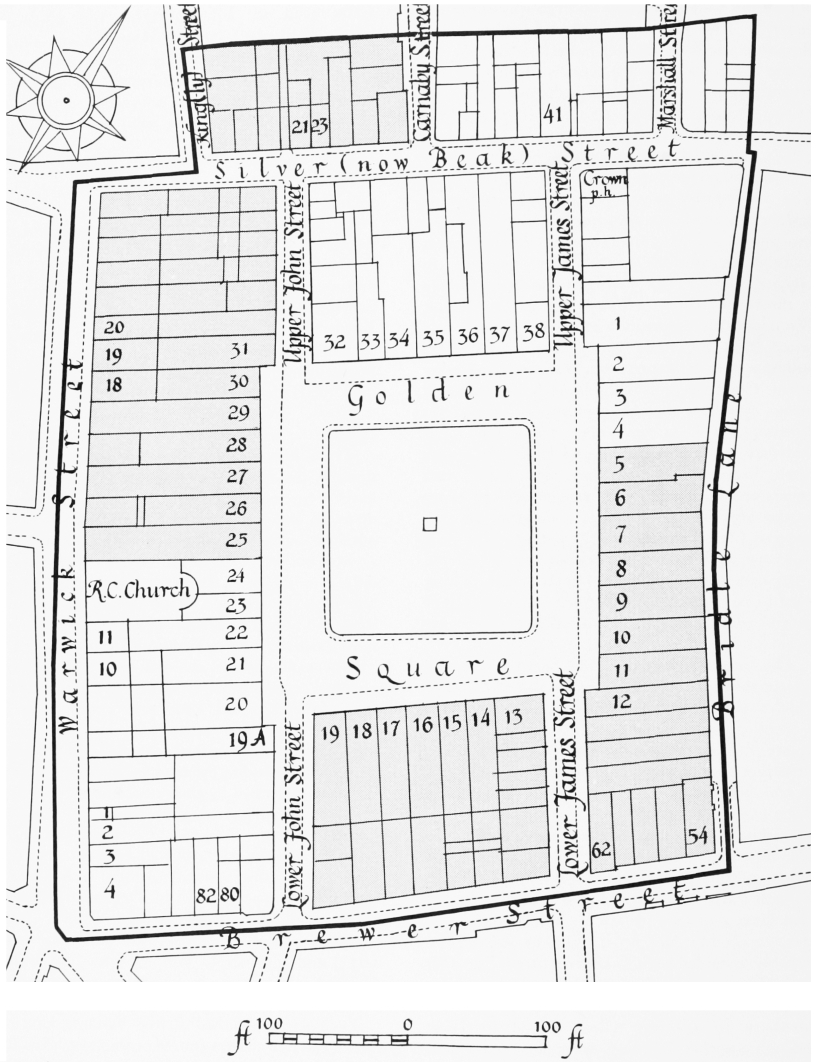
By 1673 the stretch of land north of Piccadilly Circus was under the joint ownership of brothers John and James Baker. Halfway through their original plan of redeveloping the Golden Square area they had a falling out and the streets leading to the new square were developed separately. This is reflected in the names of Upper and Lower John Street (on which Lingo is located) and Upper and Lower James Streets.
This is my resolution for 2017, jointly inspired by the best 👏 holiday 👏 ever👏 (video below) and this Time Out list of the best ramen in London. I also managed to convince InaneAdam to join me, because I heard it’s important to have moral support with such challenging goals.
Halfway through our first bowl we decided to write reviews of the places we visit, so here goes….
There are some great places near Kingly Court (I’d especially recommend the Crispy Lamb Fries from nearby Dirty Bones), but all this means Shoryu is somewhere I’ve walked past but never gone in. Clearly displayed in the window it said ‘we do not seat incomplete parties’ so I waited outside for a good 10 minutes before realising Adam was already sat inside.
Finally both inside, we each ordered a cocktail, a steamed bun and a bowl of ramen.
The drinks arrived first; my delicious gingery Fuyu Lemon and Adam’s green and cucumbery Matcha Detox, which he enjoyed but wasn’t to my taste.
The tangy BBQ style sauce on my chicken karaage bun was incredible; good enough, I found, to eat directly from the counter where I had dropped some. (Judge me all you want, it really was that good!) Adam’s tempura prawn bun was nice, but I definitely chose better!
The time had come for the main event. Two good sized bowls of noodles arrived before us.
I’d chosen the Dracula Tonkotsu with extra beansprouts. It was, expectedly, very garlicky due to the addition of Mayu (some rapid googling told us this is oil flavoured with burnt garlic). The sort of noodles you can taste for a while afterwards.
Adam went for the Karaka Tan Tan Tonkotsu, a spicy minced pork take on the traditional dish, but was disappointed by his egg. You can read more about this trauma in his own review.
Overall, dinner for two came to around £53, which was quite a lot more expensive than we paid for ramen anywhere in actual Japan. This does bring the score down a bit but there’s no getting away from how tasty it was.
The staff at Shoryu talk in Japanese and bang a gong every time somebody enters the restaurant which adds authenticity, they’re also fans of my resolution…
All this brings us to a final rating. Ratings are difficult with nothing to compare to, so I’m sitting on the fence for my first review. RAM (out of RAMEN, or more conventionally, ★★★☆☆). Hands-down, the best part was the sauce on the bun. For more food-porn check out Shoryu on Instagram.
As we were walking back to the Tube we passed a very small Japanese place called Lingo, which is set to be the next stop on our quest for ramen! Stay tuned for the review.
One of the things I find most interesting about the Timehop app on my phone is how much my style of posting (especially to Facebook) has changed over 10 years. The melodrama is embarrassing and entertaining in equal measure. It’s interesting to see how what I was prompted to post about has changed. (Notice how I have deliberately stayed away from labelling this change as growth!)
this isn’t me, obvs
The last blog post I wrote was waaaay back in August. I was thinking about the reasons for this, and it’s a combination of two things
Too many boxsets to catch up with on Netflix – seriously, if you haven’t seen Designated Survivor you are missing out! It’s prefect kick-back-and-relax telly for emergency managers!
A feeling that I was loosing, or at the very least, confusing my own voice with my work one. As the lead for “external relations and digital” for London Resilience, I started to find it difficult to have enough to say that was notably different from what I was already saying at work.
I had some pretty strong views back in the day. You may remember such blog posts as “Exercises are pointless” and “CBRN is elitist“. Since then (maybe because I’d already vented?) I started to find I didn’t feel as passionately about things anymore. For a while I felt I was becoming disinterested, but realised it was more about feeling I didn’t have anything new to add to the conversation.
In 2017, I want to re-establish my voice and blog. This might sound grandiose, even pompous, but I’ve found blogging helps me solidify proto-ideas. The process of writing something down means wider reading, consulting different sources, opening myself up to new ideas and discussing with colleagues.
I guess the other aspect is that the nature of being online has changed too. Is a blog the best medium? Should I, in fact, be using Medium? What’s the relationship to other platforms like Twitter and LinkedIn? These are all things I’ll no-doubt continue to unravel throughout the year. As with Timehop, I hope that one day I’ll be able to look back through my blog and see how my thoughts have evolved and what they have been shaped by.
So what is likely to follow in 2017? I think it would be unwise to commit to a regular schedule of blogging, I don’t want to be a slave to the blog. However, expect posts about the things that interest me, that frustrate me, that could be better. I’ll try not to moan too much, it’s all intended to be constructive and to help me (and perhaps others) improve what we do.
Best wished for 2017, and remember, if you want to get in touch hit me up @mtthwhgn on Twitter – I’ve love to have a conversation not just air my own thoughts.